Spring to Sprout Flowers and Appeals!

Flowers may be welcome signs of spring, but a sign that spring is here that may be less welcome is the implementation of the marketplace appeals process for employers. Beginning in 2016, the federally facilitated marketplace (FFM) will send notices to employers if an employee receives APTC and the employee has identified their employer in their application for coverage.

Section 1411 of the ACA requires exchanges to notify employers that an employee has qualified for a premium tax credit for individual coverage through the marketplace. The notice will allow an employer to provide information that the employer has offered coverage to an individual that meets the requirements of the ACA.

Generally, if an employee has an offer of coverage that meets the minimum value and affordability requirements, the employee is not eligible for a subsidy in the exchange. There will be instances in which an employee, nonetheless, could be determined eligible for premium tax credits generally based on household income. But, in many other cases employees could seek exchange coverage because of a misunderstanding of the employer offer of coverage or of the eligibility requirements for APTCs.

The notices will be phased in. Notices will be sent only if the employee received APTC for at least one (1) month in 2016. Each notice will identify the specific employee but will not contain an employee’s personal health information or federal tax information.

An employer will have 90 days to appeal the employer notice. An employer appeal request form can be found at https://www.healthcare.gov/marketplace-appeals/employer-appeals/ . The appeals notice is also used for these state-based marketplaces:

  • California
  • Colorado
  • District of Columbia
  • Maryland
  • Massachusetts
  • New York
  • Vermont.

The appeal will allow the employer to claim that the employer has offered the employee coverage that meets the affordability and minimum value requirements. The employer would also indicate whether the employee is already enrolled in the employer’s coverage.

Employers may designate a secondary contact to help with an appeal. The secondary contact may act on the employer’s behalf including communicating directly with the Marketplace Appeals Center.

A successful employer appeal will result in the employee receiving a notice from the FFM instructing the individual to update their marketplace application. The notice will explain the possible tax consequences that the individual may face if they fail to take action.

The FFM notice and employer appeal, in and of itself, will not be used to determine whether an employer will face a penalty for the employer shared responsibility provisions. The IRS is expected to rely on the information that is being submitted when an employer files the Form 1094-C and Form 1095-C.

Appeals will be filed to the following address or fax:

Health Insurance Marketplace

Department of Health and Human Services

465 Industrial Blvd.

London, KY  40750-0061

An appeal request may also be faxed to a secure fax line: 1-877-369-0129.

Once an appeal has been filed, a notice will be sent acknowledging receipt of the appeal. The employee will also receive a notice that an appeal has been filed. Once a decision has been determined it will be communicated to both the employer and the employee.

Employers should take immediate steps to identify which individuals in the firm will have the responsibility of responding to the marketplace notices. The intention of the marketplace is to send notices to employers using addresses provided by the marketplace applicant. As such, employers may find that the address an employee used may not be the location designated by the employer to address these notices. So, employers should communicate within the company how they will handle receipt of these notices to ensure that the employer can respond in a timely fashion.
 

Employees Need to Beware Subsidy Farsightedness

People who are farsighted see things that are far away more clearly than they see something close to them. So it is with employees who have their eyes focused on the Affordable Care Act’s individual market subsidies.

A number of Compliance Corner questions are variations of: “If an employee has an offer of coverage through their employer that meets minimum value and is affordable can they enroll in an exchange marketplace plan and receive a subsidy?”

The short answer is “no.” An employee who is offered a health plan at work with a contribution for employee-only coverage that costs no more than 9.66% of the employee’s household income is not eligible for premium tax credits through the subsidy.

Employees who lament this fact may need to refocus their sight on the subsidy that’s right in front of them – the generous subsidies that they receive through their employer’s plan. The payments that an employer makes toward an employee’s health coverage are exempt from federal income and payroll taxes. And, if the employee’s state has a state income tax the premiums are excluded from the state income tax as well. This exemption of employer paid health premiums is generally referred to as “the employer exclusion.”

This tax exclusion amounts to a sizeable subsidy for many taxpayers. And, there is no guesswork about whether income will change during the year that would impact the employer exclusion as there is with the individual subsidy. H&R Block has just announced that returns they’ve processed so far for the 2015 tax year have 3 in 5 customers having to pay back some of their subsidies with the average repayment totaling $579.

In addition to this employer exclusion, most employers have implemented “premium only” plans that exclude any employee contributions toward health coverage from taxable income. The result is that the entire cost of health insurance is “tax-free” to the employee.

It would be even more short-sighted to focus entirely on the cost of a plan or the tax benefits of one. The plans available through employers often feature broader networks of medical providers and many have lower deductibles and out-of-pocket costs than those available in the individual market.

Subsidies for individual coverage help make health insurance coverage more affordable, of that there is no question. But, individuals who ignore the subsidies available to them through an employer’s plan may not be seeing clearly at all.

Short Term Policies No ACA Panacea

An insurance product that many thought would become extinct with implementation of the ACA can’t be counted out – yet. Short term health insurance policies have been an attractive short-term option for many years. While the policies generally offer limited benefits, the ability to purchase a plan for 30 days or 6 months or even 360 days has had an appeal for people who needed to bridge an insurance gap.

While these policies are attractively priced, they may come with an unexpected cost. Short-term medical plans are limited coverage and, as such, the coverage does not count as MEC (minimum essential coverage) for ACA purposes. So, despite having health coverage, an enrollee in a short-term plan will still be subject to the individual responsibility penalty. And, with the penalty for 2016 now at $695 or 2.5% of household income above the filing threshold, the short-term plan may not be the bargain a consumer planned for.

What are some of the distinctions between short-term plans and ACA compliant plans?

Short-Term Plan                ACA Compliant Plan

No                                                Yes                          Coverage for pre-existing conditions

No                                                Yes                          Preventive care without cost sharing

Yes                                                No                           Enrollment at any time

No                                                 Yes                          Guaranteed renewable

Yes                                                 Yes                          Sold by respected health insurers

Brokers who sell this line of coverage apprise their consumers of the limitations on these policies, especially the possibility of incurring the individual tax penalty. These limited policies may be an option to consider when someone has missed the ACA open enrollment period or has some other temporary need. But, it’s important that consumers understand the limitations and the consequences of this insurance product.

Employer Reporting When Employee Waives Coverage

Many employers are struggling with the ACA’s employer reporting requirements. It’s hard enough to know what to report when an employee enrolls in coverage. But, what is the proper way to report that an employee has waived coverage?

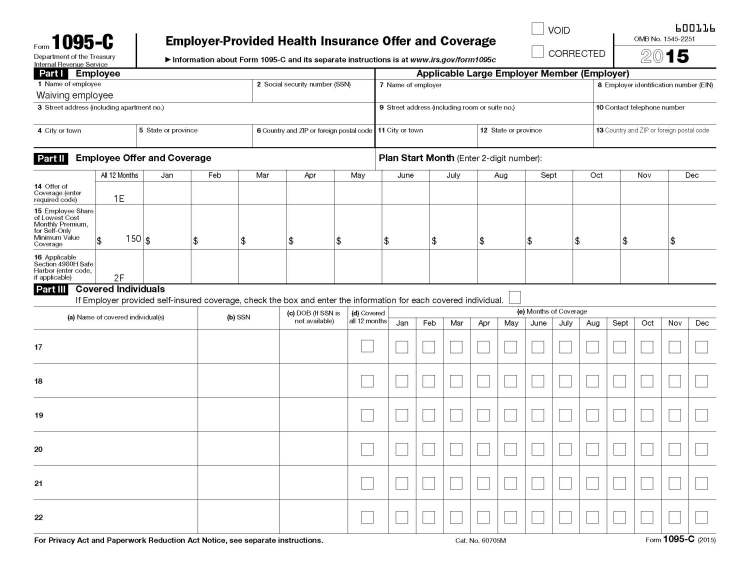
Line 16 becomes very important in this scenario. If the employer has adopted an affordability safe harbor, the code for the chosen safe harbor will appear in line 16.

There are three (3) safe harbor affordability codes. These are:

  • 2F The W-2 safe harbor (Box 1 of the W-2)
  • 2G The Federal Poverty Line safe harbor
  • 2H The rate of pay safe harbor.

The example below shows code 2F. However, depending on the employer and the employee class, the safe harbor method used may vary. Of particular importance, the W-2 safe harbor must be used for all months of the calendar year for which the employee was offered health coverage.

For an IRS FAQ that describes the safe harbors see question 19 here.

If an employer has not opted to use a safe harbor, line 16 would be left blank (assuming no other codes are applicable such as transition relief). By doing so, the employer is indicating to the IRS that the employer and/or the employee may be subject to a penalty.

If an employer offers a self-funded plan, Part III of form 1095-C would also be left blank when an employee has waived coverage.

Given the penalties that employers may face if an employee does not have coverage or is not offered coverage , the importance of documenting that an employee has been offered coverage and declined it becomes even more important. Employers should obtain a signed waiver from any employees that waive coverage. In the event that an employee does not return a signed waiver, employers should note in enrollment materials that failure to respond by a certain date will be assumed to be a waiver of coverage.

Example when Employee Waived an Offer of Coverage

Facts of Assumptions:

  • Employer offers insured plan
  • Coverage for lowest cost employee premium per month is $150
  • The employee, spouse and dependents were offered coverage for all 12 months
  • The employer has offered affordable coverage using the W-2 safe harbor
  • The employee has waived coverage for everyone in the family.

blog employee waives coverage_Page_1

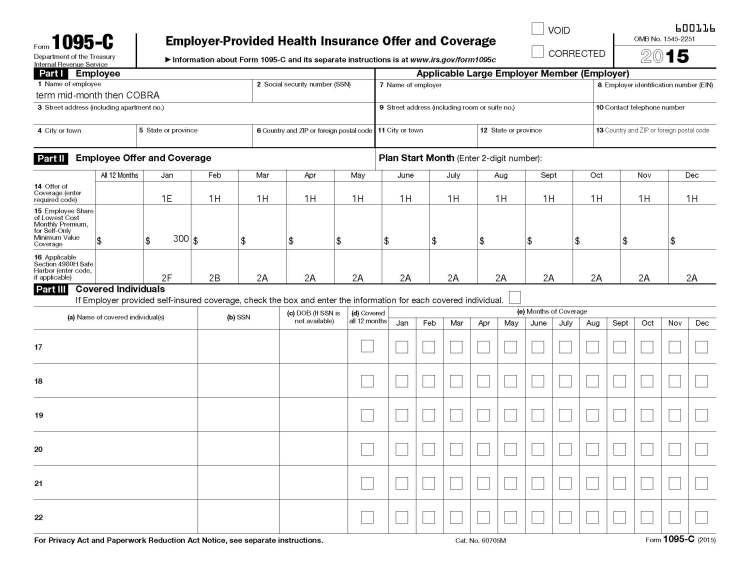
Coping with COBRA… and Employer Reporting!

Employer reporting is hard enough! But, employer reporting when there has been a COBRA qualifying event revives images of coiled snakes striking out.

Final 2015 instructions for completing forms 1094-C and 1095-C changed some of the rules related to reporting COBRA offers of coverage.

Example for Termination at end of month

 Facts or Assumptions:

  • Employer offers insured plan
  • Coverage for lowest cost employee premium is $300
  • Offer of COBRA to employee who lost coverage as a result of termination on last day in February and former employee enrolled in coverage
  • Assumes MEC/MV coverage was also offered to former employee’s spouse and dependents as well as the former employee and only the former employee enrolled.

cobra end of month reporting_Page_1

Example for Termination during month

 Facts or Assumptions:

  • Employer offers insured plan
  • Coverage for lowest cost employee premium is $300
  • Offer of COBRA to employee who lost coverage as a result of termination mid-February and former employee enrolled in coverage
  • Assumes MEC/MV coverage was also offered to former employee’s spouse and dependents as well as the former employee and only the former employee enrolled.

cobra 2 term mid month COBRA_Page_1


Reporting Delay Shouldn’t Cause Consumer Filing Delays

The delay in reporting deadlines announced by the IRS in late December has given many employers much needed breathing room. IRS Notice 2016-4 issued on December 28, 2015 extending the filing deadlines for ACA reporting.

Employers subject to the reporting requirements face a deadline of March 31, 2016 to furnish 1095-C statements to each full-time employee. The original deadline was February 1, 2016. Information returns are due to the IRS by May 31, 2016 if filed by paper and June 30,    2016 if filed electronically. The original filing dates were February 28, 2016 for paper and March 31, 2016 for electronic filing.

The delay in filing means that employees may not have received the forms 1095-C from their employers. CMS Fact Sheet on Preparing for Tax Season notes:

 This year, many consumers with coverage from a non-Marketplace source will receive a new form in the mail called a Form 1095-B or a Form 1095-C, describing the coverage they had for the year. This form will be sent by their employer, insurance company, or the government program that provides their coverage, such as Medicare or Medicaid. Consumers do not need to attach this information to their tax return or wait to receive the form before filling their tax return. If consumers do receive one of these forms, they should keep it in a safe place with their other tax records.

The CMS Fact Sheet can be found here.

Those employers who take advantage of the filing delay should expect that some employees, or former employees, will have questions regarding tax filing. The CMS Fact Sheet may be worth sharing with them.

 Employers should note that the IRS views these delayed filing dates as the sole extensions for this year’s filings. Notice 2016-4 specifically warns that provisions regarding automatic extensions or permissive extensions will not apply to the extended due dates. The notice further warns that employers or other coverage providers that do not comply may be faced with penalties. Notice 2016-4 can be found here.

In a separate notice, penalties for late filing have been increased – again. Civil penalties that apply for ACA reporting purposes are subject to adjustment for inflation. The penalties for ACA reporting are governed by section 6721 and 6722 of the Internal Revenue Code.

The increases were announced in Revenue Procedure 2016-11 for taxable years beginning in 2015. The new amounts are:

Failure to file correct, complete statements on time
$260 per form, not to exceed $3,178,500

$50 per form if corrected within 30 days of filing
$100 per form if corrected within 60 days on or before August 1, 2016


$520 per form for intentional disregard with no limit cap


The Revenue Procedure 2016-11 can be found here.


New IRS Notice 2015-87 Announces Increase in Employer Shared Responsibility Penalties

Whatever a broker or employer knows about the ACA is subject to change with little notice. This has been the case since the ACA was enacted into law in 2010. And, the tradition continues with IRS Notice 2015-87.

IRS Notice 2015-87 is only 31 pages long. But, many of those pages warrant careful review.

Of immediate interest and concern is that the IRS has adjusted the amounts of the employer mandate penalties for 2015 and 2016. Employers who have relied on penalties remaining the same – forever – guess again!

 Question 13 of Notice 2015-87 provides the adjusted amounts of the employer mandate penalties for 2015 and 2016.

2015- Penalty A is $2,080, Penalty B is $3,120

2016- Penalty A is $2,160, Penalty B is $3,240

Question 12 states that the IRS will amend the employer mandate regulations so that the employer affordability safe harbors are adjusted for inflation to coordinate with the affordability measure used by the exchange. The question states that employers may relay on the 9.56 percent affordability safe harbor for plan years beginning in 2015 and 9.66 percent for plan years beginning in 2016. The previous affordability rate was 9.5 percent.


The IRS notice can be read in its entirety here.


ACA Terms and Acronyms Brokers Need to Know

There are a handful of terms and acronyms that relate to the ACA that health insurance brokers need to understand as readily as they understand texting’s LOL! In some respects, the ACA has caused brokers to learn a new language.

ALE         Pronounced as each letter – A-L-E or like the beer – ale

An ALE is an “applicable large employer.” To be an ALE, an employer must have 50 or more full-time and full-time equivalent employees based on the prior calendar year.

FTE

FTE refers to full-time equivalents. This can be a catch all term that would include full-time and full-time equivalent employees or it can be referring solely to full-time equivalent employees. It is important to understand how the term is being used, particularly when determining ALE status. FTEs are calculated by adding the number of hours of service for each employee each employee who was not a full-time employee during a month, up to a maximum of 120 hours and dividing by 120.

MV

MV stands for minimum value. Minimum value is a plan’s share of the “total allowed costs of benefits provided under the plan” and includes co-pays deductibles and out-of-pocket limits. An employer plan must meet or exceed 60% of such costs to be MV.

A” Penalty — the Sledgehammer Penalty

The A penalty refers to the section of the Internal Revenue Code, Section 4980H(a), that addresses the employer shared responsibility requirements. The A penalty applies to ALEs that do not offer minimum essential coverage to full-time employees and their dependents. Whether an employer offers coverage that meets minimum value and is affordable is not relevant to the A penalty.

The A penalty is also called the sledgehammer penalty because the penalty is $2,000 times the number of full-time employees if at least one full-time employee receives a premium assistance tax credit.IRS Notice 2015-87 announced an increase in the A penalty to $2,080 in 2015 and $2,160 in 2016.

An employer is considered to offer coverage if coverage is offered to 95% of full-time employees (70% in 2015). The penalty assessment allows an employer to subtract the first 30 workers when calculating their tax liability.

This is a broad overview of the penalty. The IRS FAQs on employer shared responsibility can be found at https://www.irs.gov/Affordable-Care-Act/Employers/Questions-and-Answers-on-Employer-Shared-Responsibility-Provisions-Under-the-Affordable-Care-Act#Liability .

B” Penalty — the Tack Hammer Penalty

The B penalty refers to the section of the Internal Revenue Code, Section 4980H(b), which addresses the employer shared responsibility requirements. This is the tax that is assessed at $3,000 times the number of full-time employees who receive a tax credit from the marketplace as a result of their employer not offering coverage that is unaffordable or does not provide minimum value. IRS Notice 2015-87 announced an increase in the B penalty to $3,120 in 2015 and $3,240 in 2016.

Because this tax is expected to apply in fewer instances for an employer, if at all, it is also called the tack hammer penalty. As importantly, the assessment for the B penalty is capped at an employer’s potential tax under the A penalty.

This is a broad overview of the penalty. The IRS FAQs on employer shared responsibility can be found at https://www.irs.gov/Affordable-Care-Act/Employers/Questions-and-Answers-on-Employer-Shared-Responsibility-Provisions-Under-the-Affordable-Care-Act#Liability .

MEC – Minimum Essential Coverage

MEC is a term that has multiple meanings depending on different provisions in the law. In several cases, MEC does not refer to the content or comprehensiveness of coverage.

The individual mandate requires that a person have MEC or face a penalty unless they qualify for an exception to the individual mandate. This coverage may be that purchased in the individual market, coverage through an employer or other coverage, including government sponsored programs such as Medicare or Medicaid.

Employers are required to offer MEC to meet the employer shared responsibility requirements under Section 4980H (a).

MEC plans refer to products that have been developed in response to the ACA. A MEC plan is generally a preventive services only plan. These plans are often self-funded. A MEC plan is not typically designed to meet the minimum value requirement. These plans are generally offered as part of an employer’s strategy to avoid the A penalty.


Revised 12/18/2015


10 ACA Reporting Reminders and Tips

  1. Small employers with insured health plans do not have to provide reports to their employees or to the IRS.
  2. Employers with 50 or more full-time and full-time equivalent employees must report for this year. Transition relief does not apply for reporting purposes.
  3. Employers who will file 250 or more information returns must do so electronically using the AIR system. https://www.irs.gov/for-Tax-Pros/Software-Developers/Information-Returns/Affordable-Care-Act-Information-Return-AIR-Program
  4. Employers who are ALEs will report offers of coverage made to all full-time employees whether the employees enrolled in coverage, waived coverage or are in a waiting period.
  5. Form 1094-C provides information that helps the IRS determine whether an employer may be subject to the 4980H(a) penalty (the “no offer” penalty). Form 1095-C, particularly lines 14-16, helps the IRS determine whether an employer may be subject to the 4980H(b) penalty which may be assessed if a plan does not meet minimum value and/or affordability.
  6. Employers who are part of a controlled or affiliated group are each responsible for reporting on their own employees. These employers are not liable for reporting of any other entity in the controlled group although they will list other entities in the controlled group on the1094-C form, Part IV.
  7. Employers subject to the reporting requirements are required to furnish the 1095-C statements to each full-time employee by January 31 of the year following the calendar year for which reporting relates. Since January 31, 2016 is on a Sunday, the statements are due by February 1, 2016. As a late Christmas gift, the IRS issued Notice 2016-4 on December 28, 2015 extending the filing deadline to March 31, 2016.
  8. Information returns must be filed with the IRS by February 28, 2016 if filed by hard-copy; March 31, 2016 if filed electronically. As a late Christmas gift, the IRS issued Notice 2016-4 on December 28, 2015 extending the filing deadline to May 31, 2016 if filing by paper and June 30, 2016 if filing electronically.
  9. Self-insured employers – whether large or small – are subject to the reporting requirements that would otherwise apply to insurers (detailed in Section 6055).
  10. A “good faith compliance” effort is required by employers to avoid non-compliance penalties which, if assessed, can be sizeable.

Spousal Carve-Outs Gaining Traction?

A simple internet search for the term “spousal carve outs” turns up dozens of links. The surfeit of links underscores the interest that employers are showing for measures that may reduce health coverage costs.

Implementing a spousal carve-out or spousal surcharge is no small task. Employers need to consider a host of issues, not the least of which are whether there are state laws, insurance contracts or other impediments to doing so.

A prelude to changing the terms of the health plan that also is likely to save money would be undertaking a dependent eligibility audit. A dependent eligibility audit ensures that enrolled dependents – children and spouses – are eligible under the rules of the employer’s plan. A survey by a business group found that on average 7% of dependents are found ineligible. Whether these averages are solid, there is no doubt that plan sponsors have a fiduciary duty to administer the plan in the interest of the eligible participants.

Employers should weigh the pros and cons of changing the eligibility of spouses before taking action. NAHU’s Compliance Corner White Paper Spousal Exclusions and Surcharges – Considerations and Caveats discusses the administrative and legal steps to implement a spousal carve-out or exclusion.